There’s a lot of discussion about the effects of screen time on young people’s mental health. While excessive use of digital technology can sometimes be linked to poorer wellbeing, the evidence suggests that much of this relationship is driven by specific activities, particularly social media, rather than a blanket measure of screen use. At the same time, digital tools are increasingly being used to support young people’s wellbeing because they are accessible, affordable, and fit well with how many young people prefer to engage with support.
This is particularly relevant for university students. Many experience a decline in wellbeing when they move into higher education, often due to reduced social support and the related challenges of adapting to their new environment and independence. More than 30% of students meet clinical thresholds for symptoms of anxiety or depression, highlighting the need for simple, scalable ways to support wellbeing.
Building on our previous research showing benefits of mindful colouring, we wanted to know whether colouring digitally was as effective as colouring on paper. Digital colouring could offer a more accessible option, allowing people to engage in wellbeing activities wherever they are, using devices they already own. Previous studies have suggested that digital colouring can reduce anxiety and support mindfulness, but little was known about its effects over a longer period.
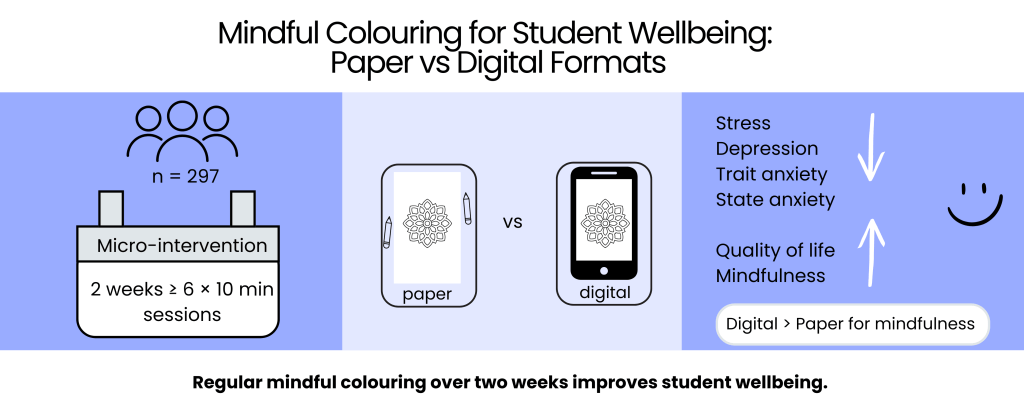
We asked 297 university students to complete at least six sessions of mindful colouring over two weeks, spending a minimum of ten minutes colouring each time. Some used paper materials and others used digital colouring apps.
We found that students who completed the colouring intervention reported lower perceptions of stress, and fewer symptoms of depression and anxiety, alongside higher mindfulness and quality of life. The largest improvements were seen in psychological and emotional wellbeing, along with personal fulfilment, overall quality of life, social-emotional support, spiritual fulfilment, and self-care. Together, these findings suggest that mindful colouring can support both psychological and to a degree also social wellbeing outside formal therapeutic settings.
Importantly, improvements were similar whether students coloured on paper or digitally. Students who started the study with lower wellbeing tended to experience the greatest benefits.
Our findings show that not all screen time is equal. Digital activities that encourage focus, mindfulness, and engagement with the present moment may offer benefits rather than risks. Digital colouring appears to be a practical and accessible way to support student wellbeing, particularly for people who may be less likely to seek formal support.
That said, colouring is not a solution to every aspect of student wellbeing. While it can help individuals manage stress and improve wellbeing, it cannot address broader challenges such as loneliness, social connection, or the pressures of university life on its own. We therefore see mindful colouring as one useful tool within a wider wellbeing strategy, rather than a replacement for other forms of support.
You can read the full paper here: https://www.tandfonline.com/doi/full/10.1080/09638237.2026.2732896
Our previous paper on paper colouring is here: https://doi.org/10.1080/17533015.2024.2419921